Friday, December 23, 2005

Revenge of the socons

As regular readers know, I've been tracking the influence of the religious right within the Conservative Party since last summer. (See here, here, and here, for example).

Nor is my concern isolated--there has been concern expressed within the Conservative party over their role. In Sudbury, for example, the nomination of a Pentacostal pastor prompted a former Conservative candidate to quit the party (here); there were similar repercussions in Richmond following Darrel Reid's nomination (here).

There are new developments on this front. There are a handful of Conservative politicians whose voting record or publicly stated positions disappoint social conservatives (cf. here). Two of the more prominent in this group are Jame Moore in Port Moody, B.C., and John Baird in Ottawa-West Nepean. Both are prominent, promising, moderate conservatives; both are potential cabinet ministers in any future Conservative government. Both now have prominent local conservatives running against them because they do not toe the anti-ssm line.

The story can be read at Lifesite, which is closely associated with the Campaign Life Coalition, an anti-abortion group.

The aim is nothing less than to defeat these two Conservatives. Consider Pacheco's statement:
“If our campaign were to attract enough votes away from the Conservative Party in Ottawa West Nepean for Baird to lose, the Conservatives will get the message that social conservatives are serious about their politics,” Pacheco emphasized. “Moreover, since the next Parliament is likely to be a minority one again, the Conservative Party, should they lose the seat this election, will think twice about running another anti-family candidate again in two years time. On the other hand, if John Baird wins, the voters of Ottawa West Nepean will likely be represented by him for years and years to come, and there will be no chance of having their socially conservative views of marriage and family represented. In fact, quite the opposite will happen.”
Similar thoughts are expressed by Greg Watrich at his website (here):
Many of us in Port Moody-Westwood-Port Coquitlam voted for our current MP in previous elections. He has served us well in many ways over the years. However, it has become clear that our local Conservative MP has rejected one of the main commitments of his party from the previous election - to defend the traditional definition of marriage. Even after massive public protests, he has chosen to support the Liberals Same-Sex Marriage Legislation.

The Conservative Party has mandated that incumbent MPs can not be challenged for the nomination to be the party candidate in the upcoming federal election. Consequently, many Conservative Party members are supporting me to challenge our MP as an Independent candidate in the upcoming election to give each of us in Port Moody-Westwood-Port Coquitlam the opportunity to vote to restore our traditional values.
The attitude reflected here is highly dangerous for the Conservative Party, and (in my opinion) for the country. Not only are social conservatives organizing to win nominations within the party (which they are entitled to do), but they're willing to wreck the party's chances in ridings where they lose. If we take Pacheco at his word, a Baird win would make the riding association more difficult to take over next time; a Baird loss gives them another kick at the can.

While there may be those who take pleasure in this Conservative civil war--"it couldn't happen to a nicer party"--I respectfully disagree. One way or the other, we will eventually have a Conservative government in this country. It would do us all good if they somehow made themselves fit for that task.

[Edited]

Thursday, December 22, 2005

Hiding Agendas (5): Cindy Silver's appearance before the senate

As I've been pointing out, Cindy Silver, the Conservative candidate in Vancouver North, wants to portray herself as a social moderate, asserting to a reporter from the North Shore News (here) that several of the positions that she publicly took as in-house lawyer for Focus on the Family were not her views, but those of her client.

This cannot stand-up to much scrutiny. In April 1996 she appeared before a senate committee discussing extending federal civil rights protections in matters of employment and provision of services to gays. You can read the whole day's testimony in Hansard (here). But this extract strikes me as especially telling:
I would want to pose the question to the Senate on this issue: How would sexual orientation be protected? I have three children between the ages of 13 and 5. If this bill is passed, what we teach them at home will be different from what they will learn at school. Already, there are pamphlets dealing with homophobia. Homophobia is everyone's problem. The fact is that I am not homophobic. I happen to believe that homosexuality is wrong. If that makes me homophobic, then these pamphlets are telling my children that their mother is homophobic and putting a very nasty name to something which I feel is a deeply held conviction."
What are we to make here of Ms. Silver's excuse that her arguments were as a lawyer and therefore potentially not her views?

Yes, she did appear at the senate as Focus on the Family's lawyer. But her argument here steps from the lawyerly to the personal. She asserts that she didn't want discrimination against homosexuals in employement to be outlawed because she thought that this would make it harder to teach her children that homosexuality is wrong. That may be consistent with her clients' view. But she is not talking about their children but her own.

For other Cindy Silver posts, follow the link.

Hiding Agendas (4): Cindy Silver's petition against recognizing gay relationships

As I've pointed out in several points, it seems that Cindy Silver, Conservative Canadidate in North Vancouver, is trying to portray herself as a social moderate. In a story about her in the North Shore News, Ms. Silver denies being a social conservative at all, and claims that she did not share all the positions that she had to take while she was lawyer for Focus on the Family. This may well be true. Only Ms. Silver knows her own mind.

There are occasions in her career where her actions seem to belie any suggestion of moderation. Here is one of them.

Parliamentary Hansard of Oct. 7, 1994:
Mr. Ted White (North Vancouver): Mr. Speaker, pursuant to Standing Order 36 I would like to present a petition from Cindy Silver and 98 others where the petitioners pray and request that Parliament not amend the human rights code, the Canadian Human Rights Act or the Charter of Rights and Freedoms in any way which would tend to indicate societal approval of same sex relationships or of homosexuality, including amending the human rights code to include in the prohibited grounds of discrimination the undefined phrase sexual orientation.
Ten years ago, Ms. Silver petitioned parliament not to allow any legal recognition of gay relationships. The fact that she is mentioned by name suggests that she not merely signed the petition, but organized it.

Now, maybe her thinking has evolved on this issue, as it has for many of us. But if that is the case, a more forthright acknowledgement of the change and complete clarity of what she will vote for is in order.

(If Ms. Silver or her agents, who seem to read this site, wish to comment, they can email me at bucketsofgrewal@mac.com)

For other Cindy Silver posts, follow the link.

Wednesday, December 21, 2005

Hiding Agendas (3): look ma, no endorsements!

As you may know, last week I posted about changes to the endorsement page at the website of Cindy Silver, Conservative Candidate for North Vancouver.

It began when someone noticed that Ms. Silver had been endorsed by Sharon Hayes, a former Reform MP who is now on the board of directors of Focus on the Family Canada, for which Silver worked. Someone decided, it seems, that Ms. Hayes' endorsement was not worth keeping and it was deleted (see here, with screenshots).

The old pages were still available through google-cache, however. Once someone noticed that the change had been noticed, the google-cache was purged (see here).

Not only that, but it seems that one of the remaining endorsements contained something that Ms. Silver's campaign managers found awkward. One of her remaining endorsements implied that she was anti-abortion. Here it is:
Cindy Silver North Vancouver


But compare yesterday's page to this morning's:

Cindy Silver North Vancouver

Notice the difference? Cindy Silver's website no longer gives links to her own endorsement page. It is, as I write this, still there if you go to http://cindysilver.ca/endorsements.php. But please go see it now. Who knows how much longer it will last?

For other Cindy Silver posts, follow the link.

Tuesday, December 20, 2005

Hiding Agendas (2): learning the code

The North Shore News recently published a fairly sympathetic story about Cindy Silver, Conservative candidate in North Vancouver which included this:
Silver is still smarting from an opinion column in the Globe and Mail several months ago that described her as a member of the "religious right." Much of the controversy stems from Silver's five-year stint as in-house lawyer for Focus on the Family, a group which has lobbied against gay marriage and been active on other social issues.

Silver says that was a job and she does not share all of the views of the organization, such as those on abortion. "I'm for respectful disagreement," she says.
Fair enough. But look again at Ms. Silver's endorsement page (which I've pasted at the botton of this post.) Among her endorsements is one from Iain T. Benson, described as a lawyer, speaker and writer. He says about her
"[Cindy Silver] is concerned about the dignity of human person – all human persons – and that is the kind of voice Canada needs more of"
So what's the problem? Unless I'm completely missing the point, "all human persons" is a code for the unborn. Mr. Benson (as you can see by googling him, is Executive Director of The Centre for Cultural Renewal, a think-tank that aims at reinvigorating the religious element in public discourse, which in itself may be a worthy goal. Most of what he writes is serious and thoughtful and deserving serious engagement in the spirit in which it is offered.

But what does Mr. Benson mean here, unless to assure to pro-lifers that Ms. Silver is one of them? She believes, he assures us, in the dignity of all human persons.

Ms. Silver wants to assure voters that she is not a prolifer, but includes on her website an endorsement that implies that she is anti-abortion:
Cindy Silver North Vancouver

(On Ms. Silver's other attempts to distance herself from the prolife, Focus on the Family see here.)

For other Cindy Silver posts, follow the link.

Hiding agendas

Blogger Koby here and here discusses again the question of why Cindy Silver, Conservative nominee in North Vancouver has removed the endorsement of Sharon Hayes from her webpage (see here). Apparently Ms. Silver's web-people have made it so that the google cache was purged (for the method, see here).

The point is not trivial one. The decision to get one person or another to endorse a candidate may be a bit arbitrary, but the decision to remove one is less so. To go to the effort of covering-up the fact that an endorsement ever existed surely suggests a clearly defined objective here: to obscure Ms. Silver's association with Focus for the Family and its director Sharon Hayes. (For some speculation about what it is in Ms. Hayes past that is so embarrassing see Koby.)

Part of this is a campaign decision. Clearly Cindy Silver wants to minimize her association with Focus with the Family, for whom she worked. And so, in the recent piece about her in the North Shore News:
Another woman tells her that she's praying Stephen Harper will get in - literally. "Prayer will do it," she says, smiling.

Truthfully, it's not the kind of comment Silver is keen to receive in public.

Silver is still smarting from an opinion column in the Globe and Mail several months ago that described her as a member of the "religious right." Much of the controversy stems from Silver's five-year stint as in-house lawyer for Focus on the Family, a group which has lobbied against gay marriage and been active on other social issues.

Silver says that was a job and she does not share all of the views of the organization, such as those on abortion. "I'm for respectful disagreement," she says.

Silver says she would have preferred to see gay marriage handled as a "civil union" - a position also put forward in the past by Bell - but isn't eager to see the issue come back to Parliament now the law has been changed. If it does, she'll poll her constituents and vote accordingly, she says.
It is difficult to know where to start here. She seems to want to describe herself as a moderate on both same-sex marriage and on abortion. There are, however, reasons to doubt this. I'll try to return this to explain why in another post.

For other Cindy Silver posts, follow the link.

Harper & the fiscal imbalance

There's a good post over at Tilting at Windmill on Harper's attitude towards the so-called fiscal imbalance. He concludes with this point:
There are only two have provinces - Ontario and Alberta. If you are in any other province “fiscal rebalancing” means less money. And if you are in Ontario all the money “saved” will come out of your pocket paying for welfare and prisons for the poorer Canadians who flood to Toronto and the Golden HorseShoe.
While I suspect this might be overstated--depending on the specific 'solution' adopted, Quebec and BC might also benefit from a rejigging of Canada's fiscal arrangements, the point remains valid. A 'tax-point' transferred to the provinces (which is probably what is at issue here) is worth more when given to Alberta than to Newfoundland, and it is worth making clear why that is: it is because the average wages are higher in Alberta and therefore the marginal rate of taxation in our progressive system is higher there. Transferring tax-points would therefore undermine one of the chief advantages of the system. Anyway, go read it for yourself here.

Monday, December 19, 2005

Canada described as 'retarded cousin' by U.S. pundit, in spate of attacks

More American attacks on Canada.

Canada described as 'retarded cousin' by U.S. pundit, in spate of attacks
By BETH GORHAM
2005-12-19 15:40:00

WASHINGTON (CP) - Canada has been described lately by a conservative U.S. television host as "a stalker" and a "retarded cousin."

Another pundit recently asked if Canadians weren't getting "a little too big for their britches." There's been a spate of Canada-bashing by right-wing media commentators in the United States ever since Prime Minister Paul Martin's complaints about lumber penalties and U.S. policy on climate change. His remarks prompted an unusual rebuke last week from the American ambassador.

The attacks on Canada have had web bloggers typing overtime and a non-profit group that's monitoring the trend, Media Matters for America, says it's disturbing.

Yet Paul Waldman, a senior fellow for the group, said Monday the criticism is confined to the usual faction that erupts whenever there's criticism of President George W. Bush's administration and it probably won't last past Canada's Jan. 23 election.

"There are always going to be occasions when it pops up. But Canada is never going to occupy an extraordinary amount of American thought," said Waldman.

"It's more like: 'Who can we beat on today?' It's never going to reach the heights of animosity toward France in the run-up to the Iraq war."

Last week, MSNBC host Tucker Carlson, a well-known conservative pundit, let loose with a string of anti-Canada rants.

"Anybody with any ambition at all, or intelligence, has left Canada and is now living in New York," he said.

"Canada is a sweet country. It is like your retarded cousin you see at Thanksgiving and sort of pat him on the head. You know, he's nice but you don't take him seriously. That's Canada."

Carlson also said it's pointless to tell Canada to stop criticizing the United States.

"It only eggs them on. Canada is essentially a stalker, stalking the United States, right? Canada has little pictures of us in its bedroom, right?"

"It's unrequited love between Canada and the United States. We, meanwhile, don't even know Canada's name. We pay no attention at all," he said.

The day before, Fox News host Neil Cavuto highlighted Martin's remark at a news conference that the United States is a "reticent nation" lacking a "global conscience" on climate change. "So have the Canadians gotten a little too big for their britches?" Cavuto asked. "Could our neighbours to the north soon be our enemies?"

Douglas MacKinnon, a press secretary to former Republican senator Bob Dole, also recently accused Canada of harbouring terrorists. "Can Canada really be considered our friend anymore?" he asked in a recent commentary in the right-wing Washington Times newspaper.

"What other question can be asked when the Canadian government not only willingly allows Islamic terrorists into their country but does nothing to stop them from entering our nation?"

U.S. Ambassador David Wilkins warned Martin last week to tone down anti-American jabs or risk hurting bilateral relations. But Martin was unrepentant, saying he would "not be dictated to" by the United States and his hard line appears to be resonating with some voters.

While the offensive from American pundits isn't widespread, it still has the potential to affect cross-border ties, said Waldman.

"On Capitol Hill, the TVs are turned to Fox News. This kind of media environment is what the White House pays attention to," he said.

"That hostility is probably shared by a lot of people in the administration."

Harper on division of seats

The following is from a story in the Edmonton Journal.
Harper made his own grassroots appeal, telling supporters Saturday in Vancouver that the current NDP bears little resemblance to the populist Tommy Douglas or Dave Barrett variety of the past.

“Today’s NDP is no longer a party of ordinary British Columbians. It’s for high taxes, it’s soft on crime, and it puts the demands of special interests ahead of the needs of ordinary working families,” Harper said.

The Tory leader made the pronouncement on the weekend after unveiling a broad “Stand up for B.C.” platform that includes the promise of more House of Commons seats for B.C., Alberta and Ontario — a potentially risky move in Quebec because it would reduce slightly that province’s relative share of seats in Parliament.

Harper, in an intense three-way race with the Liberals and New Democratic Party for B.C.’s 36 seats, predicted that Canadians will be staying up late on election night to see if West Coast voters will boot the Liberals from office.

The Conservatives are locked in a battle with the NDP in many parts of B.C., fighting over the populist, anti-establishment vote that swung to Reform in the 1990s but has started moving back to the NDP.

“British Columbia could elect some opposition MPs for a party (the NDP) that won’t change a government, or they can elect opposition MPs for a party (the Tories) that’s going to throw the entire political establishment out on its ear,” he said in an interview.

Canada’s current formula for redistributing seats every 10 years is biased against Ontario, Alberta, and B.C. because Quebec and the smaller provinces have constitutionally-guaranteed minimum number of seats.

Harper predicted that B.C. would get four more seats to go to 40, Alberta two or three more than their current 28, and Ontario would go from 106 to 116.

Quebec, which has 75 seats in the 308-seat chamber, would see its relative share of seats compared to larger provinces drop slightly under the Tory plan.

“There may be some reaction (in Quebec) on that, but we’re simply doing a fairer system here,” he said, stressing that the Constitution intended to have provinces represented based on population.

“We’ve departed simply too far from the reality.” He said there are “other ways” to deal with Quebec’s concerns, and said he’ll reveal those plans later in the campaign.
Strangely, this is cast as especially effecting Quebec. (Well, not that strangely.) In fact, however, the effect on Quebec would be minor, which would see it's share of parliamentary seats go from 75 of 308 (24.4%) to 75 of 324 (23.2%).

The real effect that this would have would be on the smaller provinces. Under the current system, PEI is overrepresented by 2, NS by 2, NB by 3, NF by 2, Manitoba by 3 and Saskatchewan by 4. Is Harper arguing for fewer seats for them?

Sunday, December 18, 2005

Saturday, December 17, 2005

Standing up for BC at whose expense?

The Conservatives have released a BC plank to their policy platform. Included within it is this statement, which deserves to be fleshed out a little:
Under a Conservative government, British Columbia will have more seats in the House of Commons and more equitable representation in the Senate.
How will this be accomplished? Changing the number of senate seats for BC is in itself a reasonable proposal--but the only way to accomplish that is to negotiate an emendation to the constitution, which is a pretty hard thing to do.

And an increase in the number of seats for BC? Perhaps that's justifiable, too, but it would be a difficult thing to do without decreasing the number of seats allotted to the Atlantic provinces, Saskatchewan, and Manitoba.

Thursday, December 15, 2005

Harper wasn't joking, he was mocking

Several bloggers, including Skippy the Wonder Dog have made some good points about the controversy about Harper and his comments to a right-wing think-tank in 1997.

Some of Harper's defenders have offered that Harper was joking, when he said. But consider the context and the butt of his jokes. This is some of what he said:
First, facts about Canada. Canada is a Northern European welfare state in the worst sense of the term, and very proud of it. Canadians make no connection between the fact that they are a Northern European welfare state and the fact that we have very low economic growth, a standard of living substantially lower than yours, a massive brain drain of young professionals to your country, and double the unemployment rate of the United States.
And he said it in front of a rightwing American think-tank.

Now, I'm not sure whether this was joking or not. (There are jokes in the speech, as one would expect.) But I think that saying that this was meant as a joke rather misintereprets the tone. Harper may indeed be looking for laughs, here. But from whom? and at whose expense?

Harper is not joking. He is mocking. And he is mocking his own country before American right-wingers in order to get a few laughs.

Personally, I don't think that's funny.

Wednesday, December 14, 2005

Why did Cindy Silver remove the endorsement of Sharon Hayes?

Everyone no doubt remembers the foofurah last May about the way in which the religious right had been able to capture Conservative nominations in several ridings.

One of the nominees about whom concern was expressed was Cindy Silver, who had been legal counsel for Focus on the Family.
Cindy Silver North Vancouver

Until recently, however, Ms. Silver's endorsement page looked slightly different. Thanks to the miracle of google-cache, we know that it looked like this (here is a screen capture):
Cindy Silver North Vancouver

Who is Sharon Hayes? She is a former Reform MP who represented Port Moody-Coquitlam from 1993-1997. Ms. Hayes is best remembered for issuing a press release on Parliamentary letter-head accusing the Chinese of eating aborted fetuses. She is now on the board of Directors for Focus on the Family Canada.

Anyway, in her words: "When I first met Cindy twelve years ago I saw in her a unique combination of skills. Here is a woman whose person priorities are in place, who gets to the crux of the legal issues and find soutions, who speaks and writes well, and is wiling to wrok with and on behalf of others. As one of the first women elected to represent the Reform/Alliance Party, I would be delighted to see Cindy take the btaon and run with int in the next Conservative government."

For other Cindy Silver posts, follow the link.

Saturday, December 10, 2005

Former candidate quits Conservatives over take-over by religious right

There's a story from Sudbury from last week that raises again the issue of the influence of the religious right within the Conservative Party.
Party over for former Tory

The man who ran for the Conservatives in Sudbury in the 2004 election has quit the party. Stephen Butcher, who came in third place behind Diane Marleau and Gerry McIntaggart, with 9,008 votes, said he no longer supports the values of the party.

“I no longer feel the Conservative Party of Canada, under the leadership of Stephen Harper and the present national council, represent the core values of the old Progressive Conservative Party of Canada prior to the merger of the two parties,” he said in a letter which he released to the media.

Butcher said he believes the party is on a mission to promote Christianity, and will make anti-abortion and anti-gay legislation a priority if they form the next government.

He also disagrees with the way in which Kevin Serviss, the present candidate for the Sudbury Conservatives, was nominated last spring. Most of the people who voted for Serviss came from the church where he is a minister, and had bought party memberships right before the nomination, he said.

The president of the riding association, Bob Bateman, said he’s sorry to lose Butcher as a party member. However, Butcher fully supported the party’s policies in 2004, he said. No rules were violated during the nomination process, said Bateman.

“I have the feeling that Stephen is smarting. He had run a hard election the last time around, and the process being what it is, he was undervoted at the convention when he would or could have been re-nominated,” he said. “I fear there may be some sour grapes here.”
(For the original story of Serviss's nomination, see the story here and here.)

Friday, December 02, 2005

GST, SSM, & CPC

There has been much discussion both in the MSM and in the Blogworld about two positions recently taken by the Conservative Party.

The first was Harper's announcement that a Conservative government would hold another vote on same sex marriage; the second was his announcement that the Conservatives would lower the GST by 1% immediately, and another 1% in the near future.

It seems to me, however, that the combination of the two is significant. The two most important parts of the Conservative coalition in this country are Social Conservatives and Fiscal Conservatives. How do these two policies reflect on that coalition?

Clearly the promise to have a vote on SSM is a gesture to the so-cons. Might a lowering of the GST as one to fis-cons? Here there is a problem.

GIven a choice as how to lower taxes, most conservative economists argue strongly that it is economically better to tax consumption (like the GST does) than to tax production though the capital gains or income taxes. (See the survey of economists' views, here).

What's interesting about the Conservatives' two big policy announcements of the election is that it reinforces the idea that fiscal conservatives are less influential in the party than social conservatives.

Sunday, November 13, 2005

Buckets of inquisition

With a hat-tip to the Wingnuterer, I took the 'which Monty Python character are you' test and got the followin results:
You are a cardinal! You love to try & get others into trouble, even if you have to make up lies...NO ONE expects the Spanish Inquisition!
You are a cardinal! You love to try & get others
into trouble, even if you have to make up
lies...NO ONE expects the Spanish Inquisition!


What Monty Python Sketch Character are you?
brought to you by Quizilla

Saturday, November 12, 2005

NP story on Evangelical activism

The National Post has a story today on a conference at the Crossroads Centre (which is where 100 Huntley Street is based). It is being organized by Tristan Emmanuel, who had appeared in the news last spring when stories about an alleged evangelical take-over of the Conservative Party.

Canada: Christians seek voice in politics: Evangelicals 'mocked'
Siri Agrell, National Post


Saturday, November 12, 2005


BURLINGTON, Ont. - With its neatly arrayed chairs and Christmas decorations, the atrium of the Crossroads Centre looks more ready to host a nativity play than a political workshop.

But 150 evangelical Christians from across the Golden Horseshoe region of southern Ontario will gather here today, outside the studio where the evangelical TV show 100 Huntley Club is filmed, for a lesson in political activism.

"In order to see anything different in Ottawa, we need to see a change in our culture," said Tristan Emmanuel, a conference organizer and executive director of the Equipping Christians for the Public-square Centre. "People need to change. The church needs to change."

In the United States, the Christian community has emerged as an influential force behind the current Republican administration and the impetus toward faith-based initiatives.

Mr. Emmanuel believes that a similar move is necessary in Canada, but it is up to evangelical voters -- not political leaders -- to drive the agenda.

So Mr. Emmanuel is planning a televised town hall meeting in January, coinciding with a possible election call, when Christian Canadians could discuss their beliefs and priorities in an open forum.

By organizing events around political involvement rather than partisan stripes, he hopes party leaders will recognize the electoral advantage of acknowledging the Christian community in their campaigns.

"They're politicians and a politician won't take a step unless it's politically advantageous," he said.

Three million evangelical Christians live in Canada, a voting bloc whose political voice should not be dismissed or underestimated, Mr. Emmanuel said.

Christians have long been vilified by the Liberal party, he said, a trend crystallized by the public derision heaped on the creationist beliefs of former Canadian Alliance leader Stockwell Day.

"People like myself have been mocked over that issue," said Mr. Emmanuel, who is studying at the McMaster Divinity College in Hamilton, Ont. "You would never do that with anyone else's religious views."

During Mr. Day's unsuccessful campaign to unseat the Liberals, Mr. Emmanuel said many evangelical Christians watched as religion was used to undermine Mr. Day's credibility as a leader, in spite of the fact that both former prime minister Jean Chretien and his replacement Paul Martin are avowed Roman Catholics.

But Mr. Emmanuel said he reached his breaking point during the 2004 federal election, when the Liberal government threatened the electorate with the Conservative party's "hidden agenda," which he believes was a thinly veiled attack on Christian beliefs.

"They used a strategy to vilify a natural constituency of the Conservative party," he said. "Normally you go after your opponent, not a specific community who might support him."

That was the moment he decided evangelicals had to demonstrate their political influence, not by throwing their weight behind a specific candidate but by making their voices heard at all levels of politics.

"Ideally, what we want to be is an organization that defends and advocates for Christians who want to be involved in the public square," Mr. Emmanuel said.

To that end, the conference has not invited MPs or would-be candidates to speak today, but rather Christian activists who believe their beliefs have been misrepresented or maligned.

"I basically looked at the last 10 years of political marginalization of the Christian view," he said of the invited speakers. "I think what people will take away is that this is happening, this mistreatment of our standpoint is not theoretical."

One of the speakers who will address attendees today is Chris Kempling, a B.C. teacher who was suspended from his job as a guidance counsellor after writing a series of letters to his local paper that criticized same-sex relationships.

The conference will also hear from Stephen Bennett, a U.S. radio personality, musician and public speaker who has flown to Canada to discuss his personal rejection of homosexuality. A self-professed "former homosexual," Mr. Bennett is now married to a woman and has dedicated himself to reaching out to "homosexuals who want to escape the lifestyle."

Mr. Emmanuel said the evangelical community is not necessarily going to fall in line behind Mr. Harper's Conservatives.

"I want to be careful not to be too critical, but I think Stephen Harper could do a better job defending our community," he said. "To be honest, I was shocked at his inability to fight for his beliefs and to keep the [sponsorship scandal] in the forefront of the debate."

Contrary to popular belief, he said evangelical voters are not politically monolithic.

Christians interested in social outreach and other "compassionate endeavours" might have a natural proclivity toward Liberal or NDP candidates, he said. But he said it is the public disavowals of religion that push the evangelical constituency toward the Conservatives.

"If you constantly marginalize us, that's when we could galvanized into one voting bloc," he said. "But really we're all over the map. We're pretty open-minded people."

Friday, November 04, 2005

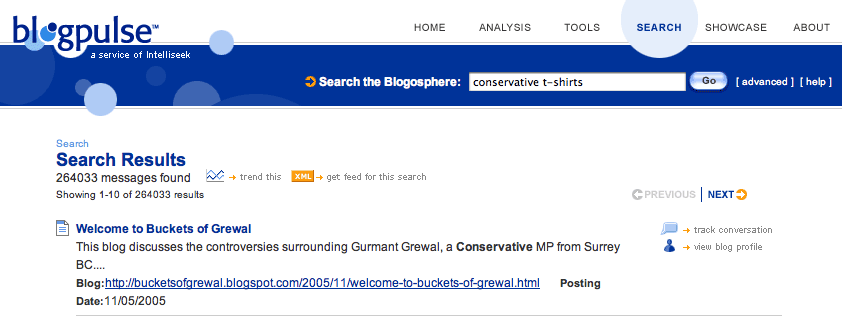
The quantum mechanics of search engines

Most of the time, they do most of what you expect. Sometimes, however…

To see what I mean,
  1. go to blogpulse.com.
  2. In their search window, type "conservative t-shirts"
  3. hit return
Here is a screen capture of what I got on Nov. 4th:

Tuesday, November 01, 2005

Here's an interesting one…

Literally, A Web Log, is a blog dedicated to track the abuse of the word 'literally'. Hmm. And people think Buckets of Grewal is weird….

Wednesday, August 24, 2005

August 24, 2005: Jakarta Post: Police target illegal institutes

The Jakarta Post
August 24, 2005
SECTION: 4

POLICE TARGET 19 MORE 'ILLEGAL' INSTITUTES

After sealing off the Institut Manajemen Global Indonesia (IMGI) for allegedly selling fake academic titles, the National Police said on Tuesday they were investigating 19 additional educational institutions. National Police spokesman Sr. Comr. Saud Usman Nasution said the 19 institutions were reportedly operating in Jakarta without licenses from the Directorate General of Higher Education at the Ministry of National Education.

The institutes include the International University Transfer Program, the International Agyata Foundation, the American Management University, the American International Institute of Management and Technology, the Washington International University, San Pedro College of Business Administration and Kennedy Western University.

"Their operations are similar to that of IMGI, which offered fake diplomas to the public for small amounts of money," Saud said.

He said the names of the 19 institutions had been obtained from the Ministry of Education.

The police have yet to make any arrests and are still gathering evidence against the institutes.

IMGI was reportedly working with American World University, Northern California Global University, Jakarta International Management Studies and Senior University to issue allegedly unauthorized diplomas, ranging from bachelor's degrees to doctorates.

As the investigation proceeded into IMGI, its graduates began to return their fictitious diplomas to the police.

Another National Police spokesman, Brig. Gen. Soenarko, said his office received a master's and a PhD issued by IMGI in May 2001.

The academic certificates were turned in by a graduate identified only by the initials SW.

"We promise that graduates who willingly return their certificates will face a less harsh punishment," Soenarko said.

He said the IMGI database showed that more than 100 PhDs and approximately 400 masters of science were issued by the institute.

To receive the degrees, it is alleged people simply had to pay between Rp 1.5 million (US$ 150) and Rp 5 million.

Several top government officials, including a former vice president and former Cabinet ministers, along with Muslim clerics and a number of retired senior police officers, are among the some 5,000 graduates of IMGI.

If these graduates are found to have used their academic titles from the unregistered educational institute, they could face up to five years in jail or a maximum fine of Rp 500 million (US$ 50,500), according to the National Education Law.

Eva C. Komandjaja, The Jakarta Post, Jakarta