You are a cardinal! You love to try & get others
into trouble, even if you have to make up
lies...NO ONE expects the Spanish Inquisition!
What Monty Python Sketch Character are you?
brought to you by Quizilla
Sunday, November 13, 2005
Buckets of inquisition
With a hat-tip to the Wingnuterer, I took the 'which Monty Python character are you' test and got the followin results:


Saturday, November 12, 2005
NP story on Evangelical activism
The National Post has a story today on a conference at the Crossroads Centre (which is where 100 Huntley Street is based). It is being organized by Tristan Emmanuel, who had appeared in the news last spring when stories about an alleged evangelical take-over of the Conservative Party.
Canada: Christians seek voice in politics: Evangelicals 'mocked'
Siri Agrell, National Post
Saturday, November 12, 2005
BURLINGTON, Ont. - With its neatly arrayed chairs and Christmas decorations, the atrium of the Crossroads Centre looks more ready to host a nativity play than a political workshop.
But 150 evangelical Christians from across the Golden Horseshoe region of southern Ontario will gather here today, outside the studio where the evangelical TV show 100 Huntley Club is filmed, for a lesson in political activism.
"In order to see anything different in Ottawa, we need to see a change in our culture," said Tristan Emmanuel, a conference organizer and executive director of the Equipping Christians for the Public-square Centre. "People need to change. The church needs to change."
In the United States, the Christian community has emerged as an influential force behind the current Republican administration and the impetus toward faith-based initiatives.
Mr. Emmanuel believes that a similar move is necessary in Canada, but it is up to evangelical voters -- not political leaders -- to drive the agenda.
So Mr. Emmanuel is planning a televised town hall meeting in January, coinciding with a possible election call, when Christian Canadians could discuss their beliefs and priorities in an open forum.
By organizing events around political involvement rather than partisan stripes, he hopes party leaders will recognize the electoral advantage of acknowledging the Christian community in their campaigns.
"They're politicians and a politician won't take a step unless it's politically advantageous," he said.
Three million evangelical Christians live in Canada, a voting bloc whose political voice should not be dismissed or underestimated, Mr. Emmanuel said.
Christians have long been vilified by the Liberal party, he said, a trend crystallized by the public derision heaped on the creationist beliefs of former Canadian Alliance leader Stockwell Day.
"People like myself have been mocked over that issue," said Mr. Emmanuel, who is studying at the McMaster Divinity College in Hamilton, Ont. "You would never do that with anyone else's religious views."
During Mr. Day's unsuccessful campaign to unseat the Liberals, Mr. Emmanuel said many evangelical Christians watched as religion was used to undermine Mr. Day's credibility as a leader, in spite of the fact that both former prime minister Jean Chretien and his replacement Paul Martin are avowed Roman Catholics.
But Mr. Emmanuel said he reached his breaking point during the 2004 federal election, when the Liberal government threatened the electorate with the Conservative party's "hidden agenda," which he believes was a thinly veiled attack on Christian beliefs.
"They used a strategy to vilify a natural constituency of the Conservative party," he said. "Normally you go after your opponent, not a specific community who might support him."
That was the moment he decided evangelicals had to demonstrate their political influence, not by throwing their weight behind a specific candidate but by making their voices heard at all levels of politics.
"Ideally, what we want to be is an organization that defends and advocates for Christians who want to be involved in the public square," Mr. Emmanuel said.
To that end, the conference has not invited MPs or would-be candidates to speak today, but rather Christian activists who believe their beliefs have been misrepresented or maligned.
"I basically looked at the last 10 years of political marginalization of the Christian view," he said of the invited speakers. "I think what people will take away is that this is happening, this mistreatment of our standpoint is not theoretical."
One of the speakers who will address attendees today is Chris Kempling, a B.C. teacher who was suspended from his job as a guidance counsellor after writing a series of letters to his local paper that criticized same-sex relationships.
The conference will also hear from Stephen Bennett, a U.S. radio personality, musician and public speaker who has flown to Canada to discuss his personal rejection of homosexuality. A self-professed "former homosexual," Mr. Bennett is now married to a woman and has dedicated himself to reaching out to "homosexuals who want to escape the lifestyle."
Mr. Emmanuel said the evangelical community is not necessarily going to fall in line behind Mr. Harper's Conservatives.
"I want to be careful not to be too critical, but I think Stephen Harper could do a better job defending our community," he said. "To be honest, I was shocked at his inability to fight for his beliefs and to keep the [sponsorship scandal] in the forefront of the debate."
Contrary to popular belief, he said evangelical voters are not politically monolithic.
Christians interested in social outreach and other "compassionate endeavours" might have a natural proclivity toward Liberal or NDP candidates, he said. But he said it is the public disavowals of religion that push the evangelical constituency toward the Conservatives.
"If you constantly marginalize us, that's when we could galvanized into one voting bloc," he said. "But really we're all over the map. We're pretty open-minded people."
Friday, November 04, 2005
The quantum mechanics of search engines
Most of the time, they do most of what you expect. Sometimes, however…
To see what I mean,
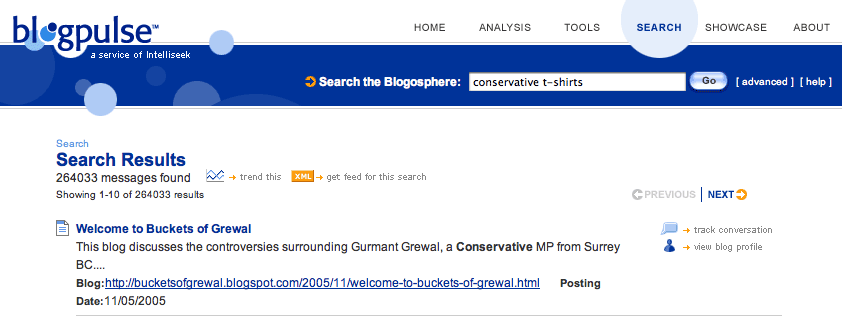
To see what I mean,
- go to blogpulse.com.
- In their search window, type "conservative t-shirts"
- hit return
Tuesday, November 01, 2005
Here's an interesting one…
Literally, A Web Log, is a blog dedicated to track the abuse of the word 'literally'. Hmm. And people think Buckets of Grewal is weird….
Wednesday, August 24, 2005
August 24, 2005: Jakarta Post: Police target illegal institutes
The Jakarta Post
August 24, 2005
SECTION: 4
POLICE TARGET 19 MORE 'ILLEGAL' INSTITUTES
After sealing off the Institut Manajemen Global Indonesia (IMGI) for allegedly selling fake academic titles, the National Police said on Tuesday they were investigating 19 additional educational institutions. National Police spokesman Sr. Comr. Saud Usman Nasution said the 19 institutions were reportedly operating in Jakarta without licenses from the Directorate General of Higher Education at the Ministry of National Education.
The institutes include the International University Transfer Program, the International Agyata Foundation, the American Management University, the American International Institute of Management and Technology, the Washington International University, San Pedro College of Business Administration and Kennedy Western University.
"Their operations are similar to that of IMGI, which offered fake diplomas to the public for small amounts of money," Saud said.
He said the names of the 19 institutions had been obtained from the Ministry of Education.
The police have yet to make any arrests and are still gathering evidence against the institutes.
IMGI was reportedly working with American World University, Northern California Global University, Jakarta International Management Studies and Senior University to issue allegedly unauthorized diplomas, ranging from bachelor's degrees to doctorates.
As the investigation proceeded into IMGI, its graduates began to return their fictitious diplomas to the police.
Another National Police spokesman, Brig. Gen. Soenarko, said his office received a master's and a PhD issued by IMGI in May 2001.
The academic certificates were turned in by a graduate identified only by the initials SW.
"We promise that graduates who willingly return their certificates will face a less harsh punishment," Soenarko said.
He said the IMGI database showed that more than 100 PhDs and approximately 400 masters of science were issued by the institute.
To receive the degrees, it is alleged people simply had to pay between Rp 1.5 million (US$ 150) and Rp 5 million.
Several top government officials, including a former vice president and former Cabinet ministers, along with Muslim clerics and a number of retired senior police officers, are among the some 5,000 graduates of IMGI.
If these graduates are found to have used their academic titles from the unregistered educational institute, they could face up to five years in jail or a maximum fine of Rp 500 million (US$ 50,500), according to the National Education Law.
Eva C. Komandjaja, The Jakarta Post, Jakarta
August 24, 2005
SECTION: 4
POLICE TARGET 19 MORE 'ILLEGAL' INSTITUTES
After sealing off the Institut Manajemen Global Indonesia (IMGI) for allegedly selling fake academic titles, the National Police said on Tuesday they were investigating 19 additional educational institutions. National Police spokesman Sr. Comr. Saud Usman Nasution said the 19 institutions were reportedly operating in Jakarta without licenses from the Directorate General of Higher Education at the Ministry of National Education.
The institutes include the International University Transfer Program, the International Agyata Foundation, the American Management University, the American International Institute of Management and Technology, the Washington International University, San Pedro College of Business Administration and Kennedy Western University.
"Their operations are similar to that of IMGI, which offered fake diplomas to the public for small amounts of money," Saud said.
He said the names of the 19 institutions had been obtained from the Ministry of Education.
The police have yet to make any arrests and are still gathering evidence against the institutes.
IMGI was reportedly working with American World University, Northern California Global University, Jakarta International Management Studies and Senior University to issue allegedly unauthorized diplomas, ranging from bachelor's degrees to doctorates.
As the investigation proceeded into IMGI, its graduates began to return their fictitious diplomas to the police.
Another National Police spokesman, Brig. Gen. Soenarko, said his office received a master's and a PhD issued by IMGI in May 2001.
The academic certificates were turned in by a graduate identified only by the initials SW.
"We promise that graduates who willingly return their certificates will face a less harsh punishment," Soenarko said.
He said the IMGI database showed that more than 100 PhDs and approximately 400 masters of science were issued by the institute.
To receive the degrees, it is alleged people simply had to pay between Rp 1.5 million (US$ 150) and Rp 5 million.
Several top government officials, including a former vice president and former Cabinet ministers, along with Muslim clerics and a number of retired senior police officers, are among the some 5,000 graduates of IMGI.
If these graduates are found to have used their academic titles from the unregistered educational institute, they could face up to five years in jail or a maximum fine of Rp 500 million (US$ 50,500), according to the National Education Law.
Eva C. Komandjaja, The Jakarta Post, Jakarta
Saturday, August 06, 2005
Faron Ellis' earlier 'research' on Western independence
There's been some interesting reactions to the recent story in the Western Standard that claims that separatist sentiments in the west are soaring. Over at the Grandite, it's been pointed out (here and here) that JMCK and Faron Ellis, who did this poll, is not really at an arms length from the Western Standard.
Faron Ellis is described thus in the Western Standard story:
The odd thing is that Ellis' separatism-rising-because-of-Kyoto poll (also done for JMCK) gathered its data at about the same time as Dr. Ellis had his students polling citizens of Lethbridge on their attitudes. But compare the numbers. When asked how the government should respond to the ratification of Kyoto, the JMCK poll (run by Ellis at almost exactly the same time) got these results:
Faron Ellis is described thus in the Western Standard story:
The research, which was conducted by pollster Faron Ellis, a political science professor at the Lethbridge Community College, was commissioned by the Western Standard to determine how well the federal government under Prime Minister Paul Martin has been managing the issue of western alienation–something that Martin promised to reduce as part of his 2004 election campaign.The description is probably misleading. Lethbridge Community College has no Political Science Department, so Ellis is hardly a 'political science professor', all the more since being a community college, the LCC will not have 'professors', but 'instructors'. As far as I can tell he is an instructor in 'Applied Social Sciences' and in charge of Citizen Society Research Lab, which describes itself as
"an applied research and teaching initiative specializing in quantitative public opinion studies. Each semester, Lethbridge Community College and Athabasca University students conduct one omnibus public opinion survey within the city of Lethbridge."At the site, you can find earlier student surveys, including one on one of Dr. Ellis' favorite themes, Western Independence, 'published' in March 2003, which tracked support in Lethbridge for the statement "Western Canadians should begin to explore the idea of creating their own country" and got these results:
The question is reminicent of the one in his famous 'Kyoto poll' that was released in Nov./Dec. 2002 that I mentioned here, quoting a Calgary Sun report on it.
Feb. '01 Oct. '01 Oct. '02 Strongly Support 4.7 4.6 4.6 Support 14.2 17.4 18.0 Oppose 42.7 42.0 43.4 Strongly Oppose 38.4 35.3 31.8
The odd thing is that Ellis' separatism-rising-because-of-Kyoto poll (also done for JMCK) gathered its data at about the same time as Dr. Ellis had his students polling citizens of Lethbridge on their attitudes. But compare the numbers. When asked how the government should respond to the ratification of Kyoto, the JMCK poll (run by Ellis at almost exactly the same time) got these results:
The question is, why did nearly identical questions asked at nearly identical moments get such different results?
Nothing can be done 43.8 Explore Independence 46.8 Seek to join U.S. 9.4
Friday, August 05, 2005
Fun with figures: Western separatism is declining
The recent story in the Western Standard claims that separatist sentiments in the west are soaring. 43% of Albertans agreed with the statement “Western Canadians should begin to explore the idea of forming their own country”.
This struck me as rather remiscent of a poll conducted by the same pollster and same firm three years ago. (On the methodology of that poll see here.) It asked what Albertans should do if Kyoto was confirmed: 55% said they would be open to considering separation if Kyoto were ratified.
There are, of course, two other polls that are relevant. In the last provincial election, the Separation Party of Alberta gathered 4680 votes, less than 1% of the total votes cast. Four years before that, candidates associated with the Alberta Independence Party gathered 7521 votes running as independents.
Judging from both sets of data, support for separatism is declining.
[Edited to replace Alberta Report story with a Calgary Sun story that is a little shorter and a little more direct.]
This struck me as rather remiscent of a poll conducted by the same pollster and same firm three years ago. (On the methodology of that poll see here.) It asked what Albertans should do if Kyoto was confirmed: 55% said they would be open to considering separation if Kyoto were ratified.
Calgary SunThat was the story three years ago. To judge from this, there are now fewer people willing to consider separation.
November 18, 2002 Monday, Final Edition
SECTION: News; Pg. 3
ALBERTANS IN FIGHTING MOOD; POLL SHOWS MAJORITY WOULD RATHER TALK SEPARATION THAN RATIFY KYOTO
by Michelle Mark, Calgary Sun
Most Albertans would rather talk separation than take the Kyoto Protocol lying down, results of a new poll show. In fact, more than 55% of the 1,204 Albertans approached by JMCK Polling said they would be open to those possibilities if Kyoto is ratified against Albertans' wishes.
"Support (for Kyoto) is continuing to drop in Alberta," said pollster Faron Ellis, who conducted the research. "In a hypothetical situation, if it comes down to the two options of capitulate or fight, it looks like more Albertans are willing to fight at this stage."
The poll, conducted by phone between Oct. 30 and Nov. 9 of this year, targeted a random sample of Albertans from across the province, Ellis said, adding that while JMCK Polling normally conducts the surveys on behalf of paying clients, this one was sparked primarily by his and his partners' curiosity.
The first two questions asked Albertans if they'd heard of the Kyoto Protocol and, if so, did they think the federal government should ratify it? Slightly more than 94% of respondents confirmed they had heard of Kyoto and 57% of them opposed its ratification.
The third and final question asked Albertans if the federal government ratified Kyoto against the wishes of the Alberta Government, what should Alberta do? Respondents were given the following answers to choose from:In general, Calgarians were found to have stronger opposition to ratifying Kyoto than Edmontonians, and more of a willingness to go to extremes in defiance of it.
- There's nothing we can do.
- Albertans should begin to explore other options such as independence from Canada.
- Alberta should seek to join the U.S.
Ellis, a seasoned political scientist, said he was surprised to find more than 9% of Albertans hypothetically supported the drastic measure of bypassing separation and hooking up with the U.S. "Clearly people are willing to choose the radical political approaches than sit by and do nothing," he said.
However, Ellis conceded that being in favour of discussing separation in a what-if situation and actually supporting separation are two very different things. "Certainly, different words would give you different numbers," Ellis said, adding attaching Kyoto to the issue of separation significantly drives the numbers up. "It's not as clear a read on independence itself as it is on what a fighting mood Albertans are getting into over Kyoto," he said.
- - -
BY THE NUMBERS
RATIFY KYOTO PROTOCOL BY GENDER:
Male Female Alberta * Ratify 25.0 22.7 23.9 * Don't Ratify 61.1 52.5 56.9 * Undecided 5.4 8.7 7.0 * Don't know enough 8.4 16.0 12.3
- - -
RATIFY KYOTO BY REGION:
Calgary Edmonton Total Alta * Ratify 19.1 37.5 23.9 * Don't Ratify 63.5 40.0 56.9 * Undecided 6.1 7.9 7.0 * Don't know enough 11.3 14.5 12.3
- - -
ALBERTA RESPONSES TO RATIFICATION BY GENDER:--------------------------------------------------
Male Female Alberta * Nothing can be done 40.9 46.6 43.8 * Explore Independence 49.3 44.5 46.8 * Seek to join U.S. 9.8 8.9 9.4
There are, of course, two other polls that are relevant. In the last provincial election, the Separation Party of Alberta gathered 4680 votes, less than 1% of the total votes cast. Four years before that, candidates associated with the Alberta Independence Party gathered 7521 votes running as independents.
Judging from both sets of data, support for separatism is declining.
[Edited to replace Alberta Report story with a Calgary Sun story that is a little shorter and a little more direct.]
Thursday, July 21, 2005
Equalization math 2: net benefits of the Equalization Programme
As I mentioned in my first post on equalization (here), equalization is a federal programme that is funded by federal taxes. The 'share' of the cost that falls to each province is roughly equivalent to share of the country's total taxation that that province pays.
Roughly 13% of federal taxes are collected from Albertans. Therefore, 13% of the cost of equalization is born by Albertans. Quebecers pay about 20% of federal taxes, and therefore fund 20% of the equalization. The difference, of course, is that the Quebec government gets an equalization cheque and Alberta doesn't. (This isn't accidental--that's the way the program was set up to run.)
This table attempt to sketch out in a rough way where the net benefits are. Each province's share of the tax burden is assumed to be their share of the cost of equalization.
The pattern is one that is fairly well-known. Ontario makes the largest contribution to equalization, which is perfectly appropriate given that it is almost half the country's economy; Alberta makes a large contribution given its size (13% of the cost, though having only 10% of the country's population); BC and Saskatchewan pay in more than they get out. Quebec receives the largest cheque, but on a per capita net basis the sums are quite modest.
*Note: the share of taxes is an old number and reflects only federal income taxes. So this table is useful only for illustrative purposes. If you know more recent or exact figures, by all means mention them and I'll update the table.
Update. Andrew Spicer conducted a similar exercise here and got roughly similar results. (I suspect that his numbers are better than mine.)
Roughly 13% of federal taxes are collected from Albertans. Therefore, 13% of the cost of equalization is born by Albertans. Quebecers pay about 20% of federal taxes, and therefore fund 20% of the equalization. The difference, of course, is that the Quebec government gets an equalization cheque and Alberta doesn't. (This isn't accidental--that's the way the program was set up to run.)
This table attempt to sketch out in a rough way where the net benefits are. Each province's share of the tax burden is assumed to be their share of the cost of equalization.
| % of tax burden* | Program cost (mil.) | Benefit (mil.) 2003/4 | Net benefit (mil.) | pop. (2001) | net benefit per capita | |
| Nfld | 1.05% | $113.00 | $766 | $653.00 | 512,930 | $1,273.08 |
| PEI | 0.28% | $30.60 | $232 | $201.40 | 135,294 | $1,488.61 |
| NS | 2.27% | $247.20 | $1130 | $882.80 | 908,007 | $972.24 |
| NB | 1.68% | $183.10 | $1142 | $958.90 | 729,498 | $1,314.47 |
| Que | 20.70% | $2,256.00 | $3764 | $1,508.00 | 7,237,470 | $208.36 |
| ON | 44.24% | $4,822.50 | 0 | $(4,822.50) | 11,410,046 | $(422.65) |
| MN | 2.85% | $310.80 | $1336 | $1,025.20 | 1,119,583 | $915.70 |
| SK | 2.42% | $263.00 | 0 | $(263.00) | 978,933 | $(268.66) |
| AB | 12.33% | $1,343.00 | 0 | $(1,343.00) | 2,974,807 | $(451.46) |
| BC | 11.75% | $1,280.90 | $590 | $(690.90) | 3,907,738 | $(176.80) |
| Yuk | 0.08% | $8.80 | 0 | $(8.80) | 29,900 | $(294.31) |
| NWT | 0.14% | $15.60 | 0 | $(15.60) | 40,000 | $(390.00) |
| Nun | 0.06% | $6.60 | 0 | $(6.60) | 27,400 | $(240.88) |
The pattern is one that is fairly well-known. Ontario makes the largest contribution to equalization, which is perfectly appropriate given that it is almost half the country's economy; Alberta makes a large contribution given its size (13% of the cost, though having only 10% of the country's population); BC and Saskatchewan pay in more than they get out. Quebec receives the largest cheque, but on a per capita net basis the sums are quite modest.
*Note: the share of taxes is an old number and reflects only federal income taxes. So this table is useful only for illustrative purposes. If you know more recent or exact figures, by all means mention them and I'll update the table.
Update. Andrew Spicer conducted a similar exercise here and got roughly similar results. (I suspect that his numbers are better than mine.)
Tuesday, July 19, 2005
Welcome to Bouquets of Gray
This is my second blog. The first, which was dedicated to discussing the Gurmant Grewal tapes, was more successful than I'd expected, and, given the amount of information that became available about the Grewal Affair, it became clear that if I continued to post on other questions, my work on Grewal would soon disappear into the mysts of time. Instead, I've decided to leave Buckets more or less as it is, and create a new blog. Here it is.
Down in the archives you'll find some old posts that I've moved from the Buckets site that were not related to the Grewal affair.
Down in the archives you'll find some old posts that I've moved from the Buckets site that were not related to the Grewal affair.
Monday, July 18, 2005
Equalization math
Several bloggers have already noted the new call for Alberta to separate made by Leon Craig, an emeritus professor of political science from the University of Alberta. (See especially the discussion of Muck Shoveller, a former student of Craig, here and, especially, here.) Prof. Craig has published an essay with the folksy title, 'Let's get while the gettin's good', which begins with this paragraph
First, Craig mischaracterizes equalization payments. Alberta does not make any equalization payments--check its annual budget and public accounts if you don't believe me. Equalization is a program in which the Federal Government makes payments to some, but not all, of the provinces. At the moment there are eight provinces that qualify--all but Ontario and Alberta. (If you need to review the facts about this program, see here.) It cost $8.7 billion per year in 2003-4 (here), which is about 4.6% of the federal budget of $189 billion. Where do the Feds find this money? Out of the federal budget, which comes from federal taxation, which Canadians from all provinces pay.
Second, Craig is obviously wrong to imply that Alberta's share of equalization comes to $12 billion--which would be truly remarkable for a program that costs $8.7 billion. What is Alberta's share? Strictly speaking, of course, Alberta doesn't have a share, since it makes no payments. The money for the program comes from the federal taxes paid by individual and corporate Albertans. Now, we could roughly calculate what Albertans collectively pay towards equalization, since figures are available for share of federal taxation by province. The ones I have to hand are out of date (2000, I think) and are only federal income taxes, but they should give us a rough idea:
What went wrong with Craig's math? Did he slip a decimal point? I will try to return to this in a future post*, only pointing out here that it's a good thing that Prof. Craig taught Political Science in university rather than math in high-school.
To be sure, the $250 million of graft involved in the Adscam racket is but a small portion of Alberta’s annual donation to keeping Quebec tenuously tethered to the rest of Canada, barely a week’s contribution of the $12 billion Ottawa sucks out of Alberta every year in “equalization” payments (which the Liberal party then uses to buy votes east of Cornwall), a mere $60 of the almost $3,000 that every man, woman and child in Alberta pays per year for the privilege of remaining in a federation governed for the benefit of Ontario, Quebec and cronies of the Liberal Party of Canada.The prose is, frankly, pretty sloppy, and its invective cliché, but let's leave that aside. Instead let's concentrate on the math behind his characterization of what equalization costs Alberta. Prof. Craig asserts two things here: (1) that equalization costs Alberta $12 billion per year, and (2) that this is 'sucked out' of Alberta in '"equalization" payments. (I'm not sure why he uses quotes here; perhaps someone can explain.) On the Buckets Truth Index, both statements sit somewhere between highly misleading and rank nonsense.
First, Craig mischaracterizes equalization payments. Alberta does not make any equalization payments--check its annual budget and public accounts if you don't believe me. Equalization is a program in which the Federal Government makes payments to some, but not all, of the provinces. At the moment there are eight provinces that qualify--all but Ontario and Alberta. (If you need to review the facts about this program, see here.) It cost $8.7 billion per year in 2003-4 (here), which is about 4.6% of the federal budget of $189 billion. Where do the Feds find this money? Out of the federal budget, which comes from federal taxation, which Canadians from all provinces pay.
Second, Craig is obviously wrong to imply that Alberta's share of equalization comes to $12 billion--which would be truly remarkable for a program that costs $8.7 billion. What is Alberta's share? Strictly speaking, of course, Alberta doesn't have a share, since it makes no payments. The money for the program comes from the federal taxes paid by individual and corporate Albertans. Now, we could roughly calculate what Albertans collectively pay towards equalization, since figures are available for share of federal taxation by province. The ones I have to hand are out of date (2000, I think) and are only federal income taxes, but they should give us a rough idea:
- Nfld 1.05%
- PEI 0.28%
- NS 2.27%
- NB 1.68%
- Que 20.70%
- ON 44.24%
- MN 2.85%
- SK 2.42%
- AB 12.33%
- BC 11.75%
- Yuk 0.08%
- NWT 0.14%
- Nun 0.06%
- foreign 0.15%
What went wrong with Craig's math? Did he slip a decimal point? I will try to return to this in a future post*, only pointing out here that it's a good thing that Prof. Craig taught Political Science in university rather than math in high-school.
- *For this post, see here
Sunday, July 17, 2005
Satorial snarkiness
If you haven't seen it yet, go check out My Blahg'ssartorial attacks (complete with pictures). Especially praiseworthy is that Robert is an equal opportunity drive-by shooter. Ah, the things that bring us Canadians together.
Thursday, July 14, 2005
Right 'Ho' sells himself for traffic!
Over at Right Ho!, we see just how far a once respectable blogger will stoop in order to increase his 'traffic'. First, he joins the Blogging Tories (see here); now he works a gratuitous Harry Potter reference into a title to generate hits. These surely are the blogging equivalents, respectively, of putting on the fishnets and heels and leaning into car windows. Now at last we know what the 'Ho' part means! (For a more innocent explanation, see here.)
(Of course, in broadcasting his, um, 'services', I could be accused of pimping … nah ... couldn't happen.)
(Of course, in broadcasting his, um, 'services', I could be accused of pimping … nah ... couldn't happen.)
How typical are Blogging Tories?
Over at Progressive Bloggers, Scott Tribe has a diary entry asking how much influence Blogging Tories have within the Conservative Party and concludes that their influence is minor.
There is, however, another side to this question that Scott mentions tangentially, but doesn't explore. Are the views espoused at BT typical of the Conservative party?
There is, however, another side to this question that Scott mentions tangentially, but doesn't explore. Are the views espoused at BT typical of the Conservative party?
I dont think we should be getting into the same pattern over calling all the Conservatives xenophobes or whatever just because we see a few of their bloggers state what we consider to be idiotic remarks.Fair enough. But what are we supposed to do with, say, Vitor Marciano? He is on the National Council of the CPC. How different are his views from those of the Blogging Tories generally? If you were to judge him by the BT posts he recommends to his readers, you'd have to assume that he approves of many of BT's least attractive posts. And if a member of National Council approves, should we not conclude that this is (sadly) reflective of something in the party and its activists?
Now, if Monte Solberg starts saying stupid stuff like that, and/or high ranking Conservative Party members, then we need to get concerned. But not til then.
Tuesday, July 12, 2005
Fake separatism will not work
There is a recent column of Link Byfield in the Calgary Sun advocating Alberta separatism. The article has gotten a mixed reaction. An interesting one is offered by M.K. Braaaten, who decides against separatism but recognizes its potential advantages:
Let's indeed look at Quebec, which has had some leverage. Whatever leverage they get out of separatism is due to the fact that their separatists seem to be sincerely interested in separation. They don't muse aloud about the fact that all they want is leverage in Ottawa.
However, I guess there could be some benefits of having a separatist party - and it’s precisely not to separate but to use it as leverage against the federal government. I mean, look at Quebec, they have done it for years and they have yet to separate. Quebec has used the threat to extract huge sums of money and power from Ottawa. If Alberta had a credible separatist party I’m sure Alberta wouldn’t leave because it would be given enough clout in confederation that it wouldn’t want to leave (similar to Quebec). If only we could find a separatist party leader that promised to never actually separate but to only use for power, then Alberta would be set.And here, of course, is the problem with the whole endeavor. Alberta Separatists cannot seem to make up their mind whether they are really separatists or whether they are only pretending to be separatists in order to get leverage in Ottawa. But in saying that their goal is leverage, they give away the fact that they don't want to separate and destroy any leverage that they ever could have had.
Let's indeed look at Quebec, which has had some leverage. Whatever leverage they get out of separatism is due to the fact that their separatists seem to be sincerely interested in separation. They don't muse aloud about the fact that all they want is leverage in Ottawa.
Friday, July 08, 2005
Arguments I hate, pt. 1: hypothetical hypocrisy
One of the exasperating things about reading political blogs is the low level of argumentation that we find. There is too much name-calling and cheap-shots, and not enough thinking of high quality. This is a point that I suspect most bloggers agree with, although most of us find it easier to identify posts that offend against this when they are made by the other side. Such is human nature.
It struck me thta it would be helpful to create a taxonomy of false arguments that we all (left, right, and center) might try to avoid.
With this in mind, I offer the first 'argument I hate', which I dub 'hypothetical hypocrisy'. This argument begins with a political or moral position of its target; a hypothetical situation is concocted into wihch the target is placed; the target is imagined to act against their original position and is condemned for hypocrisy.
A classic example of this came a couple weeks ago when Laurie Hawn, conservative candidate in Edmonton-Centre, wrote a post with the title 'A conflict hypocrisies', which included this swipe at Jack Layton:
This argument comes in various forms, and I invite people to include examples (left, right, and center) in the comments.
It struck me thta it would be helpful to create a taxonomy of false arguments that we all (left, right, and center) might try to avoid.
With this in mind, I offer the first 'argument I hate', which I dub 'hypothetical hypocrisy'. This argument begins with a political or moral position of its target; a hypothetical situation is concocted into wihch the target is placed; the target is imagined to act against their original position and is condemned for hypocrisy.
A classic example of this came a couple weeks ago when Laurie Hawn, conservative candidate in Edmonton-Centre, wrote a post with the title 'A conflict hypocrisies', which included this swipe at Jack Layton:
Okay everyone, hands up all who think that Canada's federal socialist leader, Jack Layton, would put himself at the back of the queue if he (or his wife) needed an MRI. I didn't think so.The original post was worded slightly differently, causing a controversy about name-calling, but let's leave that aside, and whether it is true (which it probably isn't: Layton's wife is undergoing cancer treatment and apparently gets no special consideration). What is noteworthy is the unfairness of the argument. Layton is placed in a hypothetical situation, imagined to have acted hypocritically, then condemned for hypothetical hyprocrisy. In essence, it is as if I said 'X says theft is wrong; but if his family were starving, surely he would steal; therefore x is a hypocrite'.
This argument comes in various forms, and I invite people to include examples (left, right, and center) in the comments.
Thursday, July 07, 2005
What to do about terrorism?
There are many blogs from left, right, and center condemning today's bombing in London. This is surely something that everyone in the Canadian blogosphere joins in condemning.
There are differing ideas about what should be done in response. There will inevitably be calls for military action--though the inevitable question is how to pick the target and the unfortunate possibility that some military actions will only become a recruiting tool for the enemy. So, too, police actions. Some will call for action to remove 'the causes of terrorism'. But what are those? Supposing that the ideology behind this recent outrage was caused by a lack of freedom, democracy, or any other good strikes me as extraordinarily naive. The one course we can agree on is to denounce it. But words are insufficient, and since part of the terrorist strategy is to seek publicity, terrorists are likely to believe that the harsher the condemnation, the better.
The sad fact of terrorism is that, like being in quicksand, almost anything that we do will make it worse. Yes, let us improve internal security. Yes, let us strengthen our intelligence and arrest those whom we can catch. And, yes, destroy the infrastructure where we can. But the best revenge, as they say, is living well.
There are differing ideas about what should be done in response. There will inevitably be calls for military action--though the inevitable question is how to pick the target and the unfortunate possibility that some military actions will only become a recruiting tool for the enemy. So, too, police actions. Some will call for action to remove 'the causes of terrorism'. But what are those? Supposing that the ideology behind this recent outrage was caused by a lack of freedom, democracy, or any other good strikes me as extraordinarily naive. The one course we can agree on is to denounce it. But words are insufficient, and since part of the terrorist strategy is to seek publicity, terrorists are likely to believe that the harsher the condemnation, the better.
The sad fact of terrorism is that, like being in quicksand, almost anything that we do will make it worse. Yes, let us improve internal security. Yes, let us strengthen our intelligence and arrest those whom we can catch. And, yes, destroy the infrastructure where we can. But the best revenge, as they say, is living well.
Wednesday, July 06, 2005
More on our flag
The last few days have seen several discussions about Canada's flag and its origins, largely in response to recent Conservative complaints that our current flag has an especially Liberal heritage.
When we're having this discussion, it is worth looking at an important influence, the flag of the Royal Military College.

This places the college's coat of arms on a white background between red bars. From the Royal Military College site:
When we're having this discussion, it is worth looking at an important influence, the flag of the Royal Military College.

This places the college's coat of arms on a white background between red bars. From the Royal Military College site:
The design of the RMC flag proved to be instrumental to the final selection of the Canadian flag in 1965. In fact, the former RMC Dean of Arts, Deputy Director of the Army Historical Section and author of the book The Story of Canada's Flag (Ryerson, 1965), the late George F.G. Stanley, writes that during the great flag debate in 1965, he suggested that the design of the RMC flag be used as the new National flag, substituting the College crest for the styled red maple leaf. From his idea came the flag we know today.
Church clamp down a two-edged sword
The Catholic church, as has been fairly widely reported (see, e.g., here), has begun to punish MPs who had voted for same-sex marriage and against Catholic doctrine.
Many bloggers have commented on this. Those who supported ssm were appalled; those who were opposed, enthused. My view is that the RCs (and other churches) are free to use the whip on their members if they like. But I think they would be wiser not to. There is a potential back-lash here that I think they should be wary of. It was not long ago that JFK had an uphill argument to make in trying to convince protestant America that although a Catholic he did not take marching orders from the pope. Now, the church seems to be saying that all Catholic politicians should do precisely this. But does this mean that we have to begin scrutinizing Catholic politicians more closely than others in order to find out whether they are going to impose church doctrine concerning abortion, divorce, birth control, etc., on the rest of the country? If that process begins, I can only assume that it will work to the detriment of the Church.
Many bloggers have commented on this. Those who supported ssm were appalled; those who were opposed, enthused. My view is that the RCs (and other churches) are free to use the whip on their members if they like. But I think they would be wiser not to. There is a potential back-lash here that I think they should be wary of. It was not long ago that JFK had an uphill argument to make in trying to convince protestant America that although a Catholic he did not take marching orders from the pope. Now, the church seems to be saying that all Catholic politicians should do precisely this. But does this mean that we have to begin scrutinizing Catholic politicians more closely than others in order to find out whether they are going to impose church doctrine concerning abortion, divorce, birth control, etc., on the rest of the country? If that process begins, I can only assume that it will work to the detriment of the Church.
Canada-haters, honest critics, and separatists
Over at BlogsCanada, Jim Elve calls on the right to quash Canada-haters, pointing to the collection of comments collected by Peace, Order, and Good Government. The discussion continues, and several commentators point out that many of the anti-Canada posts are not anti-Canada per se, but critical of various aspects of our character and polity, an act that need not be interpreted as anti-patriotic.
The 'smoking (shot)-gun' for the charges of Canada-haters come from comments to several entries in the Western Standard's blog (here and here). I choose several examples that I think illustrate different attitudes. First,
The calls made by Jim Elve, POGGE, and (I'm sure) others that conservative bloggers to quash anti-Canadianism misses the mark. The problem is not so much anti-Canadianism but separatism, and a tendency of conservative commentators to try to use the rise of separatism for their own political ends.
[Edited and revised]
The 'smoking (shot)-gun' for the charges of Canada-haters come from comments to several entries in the Western Standard's blog (here and here). I choose several examples that I think illustrate different attitudes. First,
"In short, a Canadian Liberal is a liar, a thief, a bigot, and narcissist, but accuse others of the same. A Canadian conservative is an honest, hardworking person who just wants to make a living and provide for their family."This post gives us no grounds to complain about anti-Canadianism. This is merely a piece of partisan polemic asserting the virtue of its political soul-mates and the vices of its opponents. This is not anti-Canada, but anti-Liberal. Compare this to
"I'm ashamed to be Canadian. Ashamed of our refusal to assist others, whether it be in the fight against terrorism or our fake committments to the tsunami relief. Our refusal to reform the UN but to instead be an intimate part of its corruption. I'm ashamed of our consistent smug superiority, our condescension to others and our utter ignorance of the hard realities of the world."Again, I don't think this is necessarily the post of a Canada-hater. Instead, it is someone who is disappointed in a series of political decisions that Canada's government has made over the last decade or so. My third case, however, is something different.
"No one can detest Canada more than I. It's racism, fascism and apartheid are all too obvious. The sooner Alberta leaves this putrid dictatorship, the better off our people will be."Here, of course, is a Canada-hater: he self-identifies. Nothing could be clearer.
The calls made by Jim Elve, POGGE, and (I'm sure) others that conservative bloggers to quash anti-Canadianism misses the mark. The problem is not so much anti-Canadianism but separatism, and a tendency of conservative commentators to try to use the rise of separatism for their own political ends.
[Edited and revised]
Tuesday, July 05, 2005
The new flag debate
 Over at BlogsCanada, Scott Tribe points out the recent anti-flag stance being increasingly taken by some Conservatives. Ezra Levant, for example, has denounced our current flag as 'Liberal':
Canada Day replaced Dominion Day the way the Liberal-red Pearson Pennant replaced the Red EnsignScott quite correctly points out the weird a-historicity of this. The Maple Leaf had been a symbol of Canada long before it was made our flag. Look at the accompanying picture of the war medal awarded to participants in repelling the Fenian raids in 1866. There is nothing very remarkable about the medal--with Queen Victoria on the obverse, a flag of victory on the reverse. But look at the field. What's that? Maple leaves. Indeed, this is the only thing about this medal that iconigraphically identifies it as 'Canadian'.

The same point could be made from the cap badge from World War I to the left. What is Canadian here? Again, it is the maple leaf. And here the maple leaf has taken over the whole medal. Clearly, then, the maple leaf was regarded as a national symbol long before it became our flag in 1965.
Where, then, did Ezra and his kind get the idea that Canada's maple leaf is a Liberal flag?
 It presumably comes from the image to the right: the Liberal Party logo, which has been made to look like the Canadian flag.
 In doing this, the Liberals have wrapped themselves in the flag, so to speak. But they are hardly alone in this. To the right is the logo of the Liberal Party in Australia. There is a flag buried there.
Or Bush-Cheney in the last American election. Again, note the flag theme.

There is nothing exceptional, then, in a political party associating themselves with national symbols, including the flag. What is exceptional is the petulant rejection of those symbols out of a misguided partisan pique.
Subscribe to:
Posts (Atom)


